
Last updated 24 November 2026
Judge samples against the house, not against a white brochure page
This guide is about window-frame colour and finish, rather than front-door colours or the choice between frame materials. County Windows already presents window colour options. The exact finish, inside-and-out arrangement and availability must be confirmed for the chosen system; this article adds no new colour range or product claim.
At a glance
- Take stock of the colours already on the house
- Choose the visual weight you want the frames to have
- Separate smooth colour from a textured effect
Take stock of the colours already on the house
Window frames sit beside a collection of permanent materials: render, brick, stone, roof coverings and external cills. Photograph the full elevation and identify the surfaces that will remain. A colour that looks attractive in isolation can appear quite different when repeated across the windows of a pale rendered house or against dark local stone.
Consider whether repainting the walls is part of a genuine plan or only a possibility. Choosing frames around a future wall colour that may never happen can leave an awkward result. Begin with the setting you know. You can still choose contrast, but it should be deliberate and assessed across the house rather than based only on a small sample beside one opening.
Choose the visual weight you want the frames to have
A contrasting frame can draw attention to the pattern of the windows, while a closer match to the walls can make that pattern quieter. The visible frame sections and glazing divisions influence the effect. A broad frame in a strong contrasting shade will not look the same as a narrow section in that shade, even across similar openings.
Separate smooth colour from a textured effect
A finish can change both colour and surface appearance. A woodgrain effect, for instance, is an appearance choice and does not change uPVC into timber. Smooth and textured samples can reflect light differently. Look closely enough to understand what you are choosing rather than assuming a printed photograph reproduces the surface reliably.
Ask which finishes are actually available in the system being quoted. Do not take a sample from one frame range as confirmation that another range can reproduce it. Where historic-property restrictions apply, material and surface detail need checking alongside colour. An effect described as traditional is not itself consent for a replacement, and its exact specification should not be left to a generic order description.
Think about the frame as seen from indoors
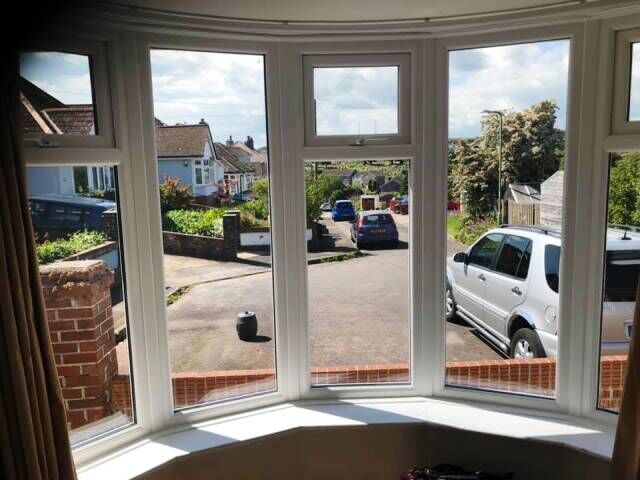
The inside of a window becomes part of the room’s decoration. Look at it beside walls, blinds, curtains and furniture rather than only from the garden. A finish that suits the exterior may be more prominent inside than you expect. Ask what inside-and-out finish arrangements are available for the actual product before assuming both surfaces must match or can differ.
Where different finishes are possible, confirm which belongs on which face and what applies to the opening section and outer frame. Discuss the appearance when the window is open too, because additional surfaces become visible. A clear written description avoids ambiguity. The front-door colour guide covers entrances separately; a window schedule needs its own inside view for each room and elevation.
Test samples in ordinary Devon daylight
View a physical sample beside the house during bright and overcast conditions where possible. Shadows and surrounding surfaces affect how a colour appears. A shaded north-facing window and a sunny rear elevation can give different impressions of the same finish. Do not judge everything from a phone screen, whose brightness and display settings can distort a comparison.
Coordinate windows without forcing every product to match
A house may include a front door, garden doors and a conservatory as well as its main windows. Matching colours can be a useful aim, but different materials and finishes may not appear identical. Ask to compare the actual samples if you want a close match. Do not assume a shared descriptive name guarantees precisely the same texture or appearance.
It can also be reasonable to choose a coordinated contrast rather than an exact match. Look at the elements together from the normal approach to the house. If a conservatory is on another elevation, its relationship may be different from that of the main front door. Decide the visual connection intentionally, and have each product’s finish recorded rather than asking generally for everything to be the same.
Plan staged replacement and care together
Replacing windows in stages introduces a consistency question. Record the product system and finish of the first stage, but do not assume availability is guaranteed indefinitely. Before deciding to phase work, ask how future matching will be approached. A new batch should be checked against the original specification rather than ordered from memory or a weathered photograph of an existing frame.
Create a finish schedule before confirming the order
List each elevation or room and the proposed external and internal finish. Add any decorative glazing separately so the colour brief does not hide another decision. Check that the quote identifies the actual frame system and finish reference. If several people are choosing, agree the final schedule rather than keeping different verbal preferences in separate conversations.
Send frontage photographs and a shortlist when you enquire with County Windows. Its uPVC and aluminium pages provide the existing material options, and the quotation can establish the available finishes for your project. Review the schedule against the samples before ordering. A considered colour choice is one that works with the whole house and remains clearly specified, not just the most appealing square on a colour chart.
Sources and further reading
Discuss your home with County Windows
Explore our uPVC windows or request a quotation for your property. Explain your priorities and the condition of the existing openings so the survey can establish an appropriate specification.